
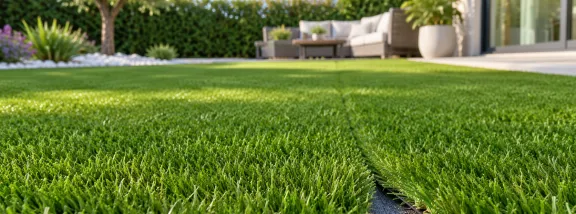
Technical guide to understand why you see a joint, how you run a correct union and what role the roll width plays.
For Victor Manuel Calvo Granadostechnical manager of ARTIFICIAL CESPED in SUMIGRAN · More than 24 years in the sector · Published: [26 / 11 / 2026] · Last revised: [26 / 11 / 2026]
Few things give away both an artificial grass installation and a visible joint. A straight line that crosses the garden, a change of tone between two cloth or a seam that opens over time.
The good news is that a well-planned and well-executed board is practically invisible. The bad news is, it's almost never fixed later without raising the lawn.
The short answer
A meeting is noted for three reasons: the fiber does not point in the same direction to both sides, the union is not well executed (separation, tape, adhesive or base) or there are more joints than necessary.
The first two depend on the installation. The third is mainly dependent on cutting and roll width planning: with 4 m rolls, most domestic gardens need half of joints or less than with 2 m rolls.
An invisible joint is not a matter of luck: it is decided before cutting the first cloth.
In this article
-
What is a meeting and why it exists
- Why a board is noted: the five cases
- How to run a correct board
- The width of the roll: 2 m against 4 m
- How the parting of a garden is planned
- When the 4 m roll is not the best option
- How to check if a board is well done
- Frequently asked questions
1. What is a meeting and why it exists
A joint is the union between two artificial grass diapers. It exists because the lawn is made in rolls of limited width and almost no garden measures exactly the same as a roll.
The usual widths in landscaping are 2 m and 4 m. Any surface wider than the roll requires to join cloth, and each union is a point that needs to be resolved well.
There are two types:
- Longitude board: Unites two diapers on its long side. It's the most common.
- Transverse or test board: Unites two diapers at its ends, when the roll does not cover the entire length.
Each assembly is an installation decision, not a product defect.
2. Why a board is noted: the five cases
Fiber direction other than on each side
The artificial grass fiber is not perfectly vertical: it has a slight inclination, the so-called hair sense. Seen in favor, the lawn is seen in one tone; seen against, of another.
If a cloth is placed turned over to the next one, the joint appears as a line between two colors, even if the product is identical. It is the most common cause and the easiest to avoid.
Incorrect separation between cloth
- Too separate: there is a strip with less fiber to see the backing or the tape.
- Too much together or overlapped: the fiber is piled and forms a small crest.
The correct separation reproduces the same space that exists between the rows of stitches of the lawn itself. So the joint continues the pattern of the tissue.
Fiber caught in the adhesive
If the fiber of the edges is stuck in the tail, it is buried and forms a visible and rough line to the touch. It happens when the fiber is not removed when the binding is closed or when it is used too adhesive.
Tone differences between cloth
Two separate roll or batch cloth may have slight tone variations. Therefore, on the same surface it is appropriate to wear cloth from the same lot and, if possible, from the same roll.
Irregular base under the board
A small step, a sunken area or a poorly compact base just below the union makes one cloth higher than the other. The straining light gives it away.
Four of the five cases depend on implementation. The fifth, from the order logistics.
3. How to run a correct board
The process has six steps. Skip any of them usually end up on a visible board.
- Check the sense of hair of all the cloth before cutting. An arrow marked on the back prevents errors.
- Refer the factory edges: The roll crust is usually irregular. One or two rows of stitches are removed by cutting the back, between rows, without cutting fiber.
- Present the cloth with the separation equivalent to the distance between rows, without hollow or overlap.
- Place the binding tape centered under the board, with the face glued up.
- Apply the adhesive in sufficient quantity and respect its open time, removing the fiber from the edges so that it does not get caught.
- Introduce the union with uniform pressure, allow to cure the time indicated by the adhesive manufacturer and brushing with counterhair to lift and integrate the fiber.
The conditions also have: with rain, ice cream or temperatures outside the adhesive range, the binding loses resistance.
SUMMARY Criterion: a well-executed joint should not be seen two steps away or noticed when passing the hand in favour of the hair.
4. The width of the roll: 2 m against 4 m
The execution decides if a meeting is seen. The width of the roll decides how many joints to run. And every board that doesn't exist is a board that can't fail.
How many together you need a garden
Examples with the handkerchiefs placed along the garden:
|
Jardín (ancho × largo) |
Rollo de 2 m: paños / juntas |
Rollo de 2 m: metros de junta |
Rollo de 4 m: paños / juntas |
Rollo de 4 m: metros de junta |
|
4 × 8 m |
2 / 1 |
8 m |
1 / 0 |
0 m |
|
6 × 10 m |
3 / 2 |
20 m |
2 / 1 |
10 m |
|
8 × 10 m |
4 / 3 |
30 m |
2 / 1 |
10 m |
|
10 × 12 m |
5 / 4 |
48 m |
3 / 2 |
24 m |
In all four cases, the 4 m roll reduces the assembly meters by half or less. In the gardens 4 and 8 m wide, the joints disappear or stay in one.
What you earn with less together
- Less visible lines in the final result.
- Less risk points: each joint is a place where the union can be opened or a gap marked.
- Less tape and adhesive, and less hours of union at work.
- More continuous areasespecially in large gardens and intensive areas.
Why don't everyone work with 4 m
A 4 m roll weighs twice as much as a 2 m roll of the same length. Moving it, storing it and cutting it requires shelves, cutting machines and vehicles prepared for that format. Without that logistics, the 4 m is hard to handle.
SUMMARY Criterion: We worked 4 m wide rolls since 2012, when we were the first in Spain to do so. Our warehouses, cutting machines and vehicles are prepared for that format, so the width does not condition the break.
5. How the parting of a garden is planned
Before ordering the lawn it is appropriate to draw a plane with the actual measurements and decide where each cloth will go. These are the rules we apply:
- Orient the hair to the main point of view, usually the house or the living area. So you see the most uniform face of the lawn.
- Place the joints in the direction of the lookNot through. A board that moves away from the observer is perceived much less than one that crosses its field of vision.
- Avoid cross-sectional joints: order full surface length diapers whenever possible.
- Full weights in the center and cuts in the edgesYou never pull narrow in the middle of the garden.
- Remove the joints from the most-passing areasfrom the exit of the house and the points where water is accumulated.
- Combine widths where appropriate: a garden of 6 m wide can be resolved with a cloth of 4 m and a cloth of 2 m, with a single joint and without waste.
6. When the 4 m roll is not the best option
The 4 m is not always the answer. There are situations where the 2 m roll works best:
- Close access: portals, stairs, elevators or corridors through which a 4 m roll does not pass without bending.
- narrow areas: elongated terraces, side stripes or balconies 2 m wide or less.
- Small spaces where a 4 m cloth would generate more cut than advantage.
- Assembly without handling means: if there are no personnel or machinery to move the roll safely.
The best width is the one that leaves less together without complicating the work. That's why you decide with the plane ahead, not by custom.
7. How to check if a board is well done
After curing and brushing, these checks allow for the assessment of the bonding without tools:
|
Comprobación |
Cómo hacerla |
Resultado correcto |
|
Vista a dos pasos |
Mirar la junta de pie, desde el punto de vista principal |
No se distingue una línea ni un cambio de tono |
|
Luz rasante |
Observar a primera o última hora, con el sol bajo |
Sin escalón ni sombra a lo largo de la unión |
|
Tacto |
Pasar la mano a favor del pelo sobre la junta |
Sin cresta, hueco ni fibra endurecida |
|
Apertura |
Separar la fibra con los dedos a lo largo de la unión |
No se ve la cinta ni una franja sin fibra |
|
Sentido del pelo |
Cepillar suavemente a contrapelo a ambos lados |
Las fibras se levantan igual en los dos paños |
If a board fails any of these tests, it should be reviewed soon: an open union tends to go to more with use. To distinguish whether the origin is in the product or installation, see our guide How to know if a problem of artificial grass is product or installation?.
Frequently asked questions
Can you hide a board that you see already?
Depends on the cause. If there is a fiber trapped or lying, a back-to-back brushing can improve it. If the problem is the direction of the hair, the separation between the cloth or a base level, you have to open the joint and redo it.
Why do you open a meeting over time?
The most common causes are inadequate adhesive, poorly focused tape, wet or cold cured, or base movements. They also influence intense transit on binding and dilations due to temperature changes.
Why do you see the two-tone lawn if there's no joint?
Because the fiber changes its inclination with the footprints, furniture or brushing, and reflects the light differently. It is not a defect: a counterhair brushing returns the uniform look.
Does the self-adhesive tape serve to join artificial grass?
For temporary or interior facilities, yes. For permanent outdoor gardens a specific adhesive binding tape is more reliable, which better supports water, sun and temperature changes.
Can I install a 4 m roll myself?
It is possible, but it takes more than one person to move it and unfold it, and a wide access to the garden. If these conditions are not met, it is better to order the custom-cut cloth.
Conclusion
A visible joint is almost never a lawn problem: it is the result of a wrong fiber direction, a poorly executed union or a more joint-like break.
The first two are avoided with method. The third, with a plane and the right roll width. The best board is the one you don't have to do, and the second best is the one nobody finds.
Are you planning an installation? Send us the measurements of your garden and we'll propose the parting with the least number of joints. If you want to check the result before deciding, we send you samples without commitment.
Article prepared by the technical team of SUMIGRAN
Artificial grass specialists for gardening and landscaping from 2.003
More than 50 models of artificial grass in collection
Comments are closed.